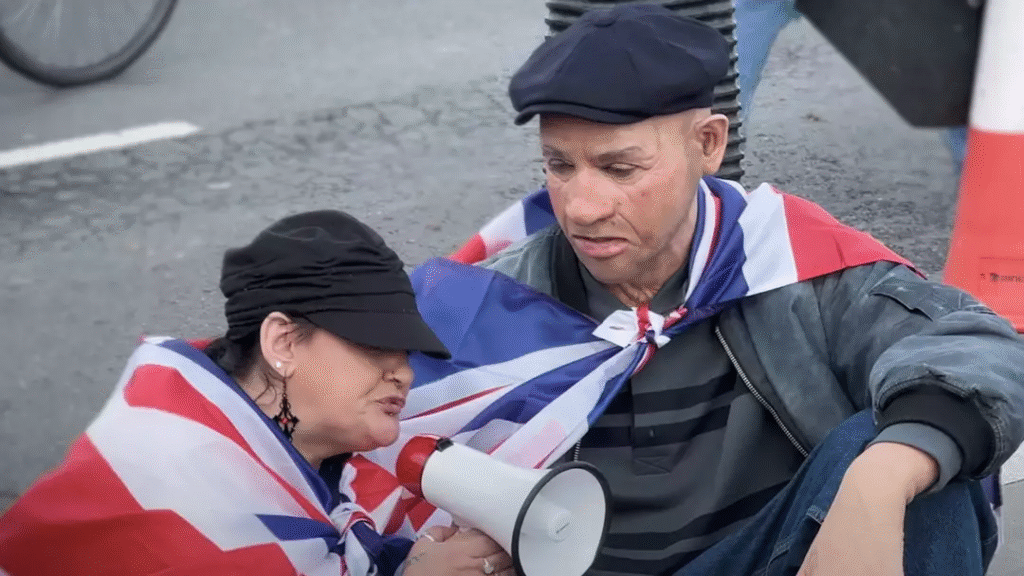
A viral undercover video by British YouTuber Niko Omilana has intensified scrutiny of the “Unite the Kingdom” march in central London this month, documenting racist and Islamophobic remarks from some attendees and prompting renewed questions about the tone and intent of the mass rally organised by far-right activist Stephen Yaxley-Lennon, known as Tommy Robinson. Disguised as an elderly white man he called “Ron Side,” Omilana filmed a series of street-level exchanges and published the 31-minute compilation on Saturday 27 September, saying he wanted to test organisers’ claims that the protest was about free speech and public order rather than race or religion. “So I decided to go undercover myself and find out people’s motivations for going, and also, see if there actually is racism, or, if it’s just one big smelly lie,” he said in the video’s opening.
The footage shows Omilana moving across packed pavements near the march route, engaging small groups and individuals who describe migrants as a threat, repeat conspiracies about Muslims and, in several cases, use racial slurs. In one sequence highlighted by news sites that reviewed the video, a woman who gave her name as Alesha said she carried three knives and would use them if she encountered a Black person at the protest, a claim Omilana captured on camera before the woman volunteered that her father was from Mauritius. Several other exchanges recorded calls to “shoot” migrants and sink small boats, according to a written summary of the most extreme remarks compiled by indy100, which declined to quote the slurs verbatim.
A separate moment, also visible in the upload, shows the mask of Omilana’s disguise slipping during a conversation with a man talking about “taking back” the country, prompting an angry reaction from nearby supporters before the YouTuber moved away. Entertainment site LadBible, which collated clips from the film after it went live, described the incident as one in which Omilana was nearly attacked after his cover slipped; its report framed the video as an attempt to test repeated assertions from rally organisers and participants that racism was neither present nor tolerated at the event.
Omilana’s closing remarks set out his own conclusion from the day’s interviews and the material captured on his hidden camera. “From this, I think it’s clear to say there’s a clear racism and Islamophobia issue in the UK,” he says. “I don’t believe everyone at this march is racist, but it’s clear a lot of racists feel very comfortable being involved, and instead of anyone here calling it out, it’s completely denied.” The video had drawn more than 1.1 million views by Sunday, according to indy100’s tally.
The “Unite the Kingdom” demonstration on Saturday 13 September drew between 110,000 and 150,000 people to Whitehall and surrounding streets, according to the Metropolitan Police, who separated the marchers from a counter-protest that they estimated at around 5,000. The turnout made it one of the largest right-wing rallies in modern times in the UK and led to hours of confrontations as officers sought to keep crowds on the authorised route. Police described “unacceptable violence,” including officers being kicked and punched and facing bottles, flares and other projectiles; they reported 26 officers injured, four of them seriously, and initially announced 25 arrests, later revising the total to 24. Reuters said the Met warned those figures were “just the start,” with Assistant Commissioner Matt Twist promising “robust police action in the coming days and weeks” to identify and charge additional suspects.
In an operational update the same day, the Met called it “a very challenging day that saw disorder, violence directed at officers and 26 officers injured,” and added that while both sides began “largely without incident,” “a number of those who were part of the ‘Unite the Kingdom’ protest became involved in disorder in multiple locations.” Subsequent clarifications from the force and fact-checkers indicate the vast majority of arrests were of people believed to be part of the main march rather than the counter-protest. A Met disclosure and two independent checks said 23 of 24 arrests — later cited as 23 total in a separate Met response — were linked to the march, not the counter-protest.
Robinson, who founded the English Defence League and has multiple criminal convictions, framed the event as a patriotic uprising. “Today is the spark of a cultural revolution in Great Britain, this is our moment,” he told supporters from a stage in Whitehall, calling the turnout “a tidal wave of patriotism.” His speech was bolstered by a video address from U.S. entrepreneur Elon Musk, who criticised Britain’s political establishment and migration policies and urged a change of government. The police estimate said crowds carried Union flags and St George’s crosses, with some marchers wearing “MAGA” hats associated with former U.S. President Donald Trump.
Prime Minister Keir Starmer later condemned what he called “plastic patriotism” at the demonstration, saying it “sent a shiver through so many of our communities who now feel more scared than they did before.” He made the remarks in an interview with Channel 4 News, which were reported by national outlets in the days after the rally. Starmer separately used a London summit in late September to urge political leaders to confront the “lies” and “industrialised infrastructure of grievance” used by populists, a section of a speech that observers linked to the scale and rhetoric of recent right-wing protests.
Omilana, 27, is an established online provocateur whose political satire and confrontational stunts have previously targeted the English Defence League in Telford and the Ku Klux Klan in the United States. A former London mayoral candidate in 2021, he has built an audience in the millions through videos that mix pranks and activism, and he has maintained a public interest in far-right movements for several years. The BBC profiled his City Hall candidacy under the headline “The system is broken for young people,” and his channel has included collaborations with the Beta Squad collective and appearances at charity football events. News coverage of his latest upload referenced that back catalogue to situate his new film in a pattern of ambush interviews and disguised reporting.
The new video also revisits a method Omilana has used before: deploying a disguise to create an unguarded environment for on-camera interactions. In the “Unite the Kingdom” footage, he wears a mask and wig to present as an older white man — the character “Ron Side” — and approaches clusters of marchers with open-ended prompts about immigration, national identity and crime. His interviews range from brief, awkward exchanges to extended back-and-forths in which individuals speak at length. The most aggressive statements in the film involve threats against minorities and migrants; Omilana’s narration states explicitly that “not everyone at this march is racist,” but concludes that many who hold extreme views appeared “very comfortable” in the crowd and that others present did not challenge them.
The scale of the march and the conduct captured in Omilana’s film are the subject of continuing police work. Two days after the event, the Met published images of multiple men sought over suspected violent disorder, an appeal that sat alongside its injury and arrest tallies. Officers said the policing plan involved more than 1,600 personnel across London because of the protest, a counter-rally, football matches and concerts on the same day. In the week that followed, fact-checking organisations rebutted claims circulating online that most arrests were of counter-protesters, citing Met updates that almost all arrests were linked to Robinson’s event.
While Omilana’s footage focuses on street-level conversations rather than stage speeches, it comes against a documented backdrop of incendiary rhetoric and scuffles. Reuters, PBS and other outlets recorded bottles and flares thrown at officers, noted four serious police injuries and described far-right politicians and online figures sharing the platform with Robinson or backing the rally remotely. The Guardian characterised the event as a record show of force for the British far right in recent decades and reported that racist conspiracy theories and anti-Muslim hate speech were repeatedly aired by participants; the paper’s accounts also stated that officers arrested people for affray, violent disorder, assaults and criminal damage.
Reactions to Omilana’s upload followed the well-worn paths of online amplification. The indy100 piece that first summarised its contents for a national audience described the video as “terrifying,” embedded Omilana’s concluding quote and curated supportive comments from public figures and viewers. LadBible repackaged several segments as short clips for social platforms and said the disguise was intended to expose the “underbelly” of racism that organisers and some attendees deny exists. Aggregated posts across X, Instagram and Reddit replayed the “Alesha” exchange and the moment the mask slipped, as well as milder encounters in which participants insisted the march was about free speech, law and order or the protection of women and girls.
Robinson and his network have long presented their events as responses to state failure on immigration and policing and reject characterisations of their followers as racist. At the 13 September rally, he cast the demonstration as a turning point, telling the crowd: “We want our country back, we want our free speech back on track,” and receiving chants and flags in reply. That framing — echoed by speakers and in supportive online commentary — is directly at odds with what Omilana recorded at ground level in the same spaces, a tension that has defined the public argument since the weekend of the march.
The Prime Minister’s intervention has given the dispute a formal political dimension, with Starmer’s “plastic patriotism” charge and “shiver” remark becoming reference points in subsequent coverage. For Omilana, who has previously staged pranks at political events and used elections as backdrops for satire, the “Unite the Kingdom” film extends a line of work that blends comedy with confrontational journalism. His risk-laden method — using a physical disguise to invite unguarded comments — remains controversial; supporters say it exposes sentiments otherwise denied in public, while critics argue that baiting and selective editing can distort context. The new upload, however, provides raw on-camera statements that stand on their own terms, and it does so inside an event whose scale and disorder are established by police and wire-service reports.
As of this week, the Metropolitan Police are continuing appeals for information about suspects from the day and have reiterated the injury figures for officers and the revised arrest total. Fact-checkers and the force’s own disclosures have pushed back on viral claims minimising the share of arrests from the main march. Against that official record, Omilana’s film offers a granular portrait of attitudes among some marchers, recorded in real time on the pavements off Whitehall and published to an audience of millions. His end-line — “I don’t believe everyone at this march is racist, but it’s clear a lot of racists feel very comfortable being involved” — summarises the contradiction he set out to test and, now, to document.